




Key Thesis & Executive Summary
- The TV may be what the patient sees, but IT, maintenance, and facilities teams inherit everything behind it. Get the infrastructure right, and the system can provide years of reliable service. Get it wrong, and the purchase can quickly turn into security issues, support tickets, and higher lifecycle costs.
- Patient entertainment includes the various in-room technologies that let patients watch television, access streaming or on-demand content, use games or relaxation media, and control the experience from the bedside.
- A complete system typically includes a display, patient controls, content, connectivity, and centralized device management.
- Patient entertainment should not be treated as a one-time television purchase.
- It is a long-term infrastructure decision involving safety, content licensing, networking, cybersecurity, device management, and support.
Interactive Patient Entertainment for the Modern Smart Hospital Room
Hospital stays can be boring and stressful. Slow hours and lack of things to do can increase feelings of loneliness and anxiety among patients. Thankfully, patient entertainment systems provide ways to ease these feelings.
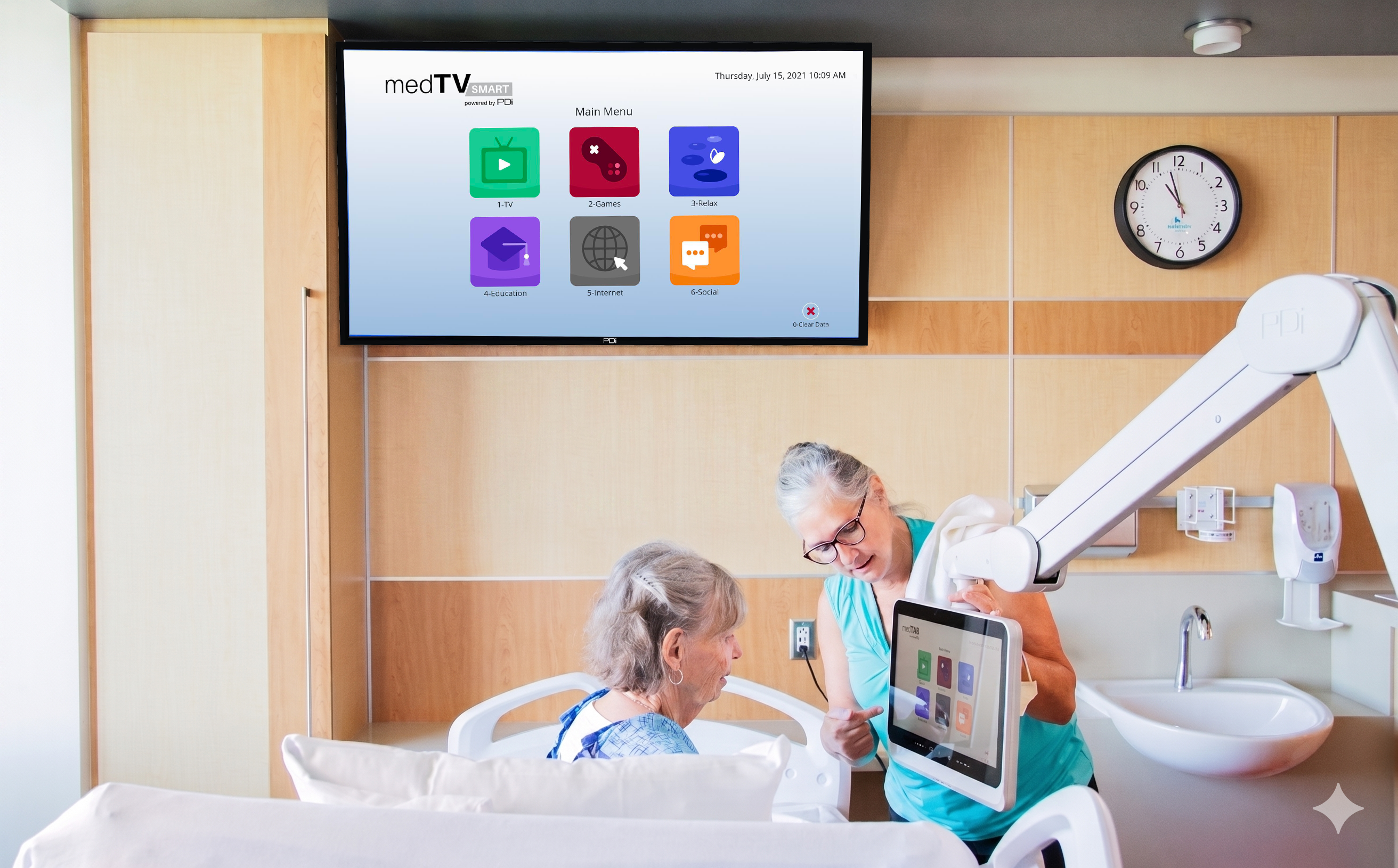
Patient entertainment doesn’t just refer to a single service. It includes the various in-room technologies that let patients watch television, access streaming or on-demand content, use games or relaxation media, and control the experience from the bedside. A complete system typically includes a display, patient controls, content, connectivity, and centralized device management.
Patient entertainment should not be treated as a one-time television purchase. It is a long-term infrastructure decision involving safety, content licensing, networking, cybersecurity, device management, and support.
This page covers the components and benefits of a patient entertainment system. It also talks about connectivity options, deployment choices for different care settings, and remote fleet management.
Why Does Patient Entertainment Matter for Modern Healthcare?
Done right, a hospital entertainment system can provide many benefits.
Improved Patient Wellbeing
Medical experts say mental wellbeing and physical health are intertwined. So reducing anxiety and stress among patients can help their recovery. A 2020 peer-reviewed study involving inpatient mental health wards found that patient entertainment such as games, music, and art improved patients' overall wellbeing. Another peer-reviewed study from 2021 shared that soothing music reduced pain, promoted relaxation, and improved sleep among ICU patients.
Reduced Nurse Calls
Patients often make more nurse calls when they feel bored and isolated. Patient entertainment and interactive bedside systems can reduce these calls by keeping patients actively engaged. This can free up some time for nurses and make them more efficient. A 2023 Mayo Clinic Proceedings Journal shared that nurses are better able to maintain high standards of care, use resources effectively, and complete tasks in a timely manner when they can work efficiently. This can reduce stress, increase job satisfaction, and improve morale.
Improved Patient Satisfaction Ratings & Financial Performance
Patient entertainment can influence patient satisfaction ratings, which are now a key indicator of healthcare quality. In the United States, the national patient experience standard for hospitals is the Hospital Consumer Assessment of Healthcare Providers and Systems (HCAHPS).
Maintaining high HCAHPS ratings can improve a hospital's public image and increase customer loyalty.
According to one Deloitte study, hospitals with high patient satisfaction scores have higher profitability. Hospitals that received excellent HCAHPS patient ratings between 2008 and 2014 had a significantly higher average net margin (4.7%) than those with "low" ratings (1.8%). The study also found that hospitals with better patient experiences earn more than they spend compared to those with lower scores.
Building a Comprehensive Patient Entertainment System
Effective patient entertainment starts with getting the right infrastructure, which in turn begins with understanding its five layers.
Interactive 5-Layer Infrastructure
Hover over or click each layer of the pyramid on the left to understand the foundational architecture of a modern patient entertainment system.
Layer 5: Remote Device Management (RDM)
The administrative command center. Cloud platforms like GENiO allow IT to remotely update firmware, configure the user interface, and securely integrate the screens with your EHR system without visiting the patient room.
Layer 4: Power & Installation
Safe, hospital-grade power architectures tailored to your facility. Includes traditional AC, low-voltage systems, Power over Coax (PoC), and Power over Ethernet (PoE) to simplify retrofits and prioritize patient safety.
Layer 3: Content Delivery
Secure signal distribution to the room. Options range from traditional RF/coax to Pro:Idiom encrypted commercial TV, network-engineered IPTV, and reliable offline entertainment applications for guaranteed uptime.
Layer 2: Bedside Controls
Direct patient interfacing. Includes UL-listed pillow speakers for private audio, seamless nurse call integration, and easy-to-navigate remotes designed specifically for patients with limited dexterity.
Layer 1: Display Options
The foundation of the visual experience. Includes UL-listed smart wall TVs, arm-mounted touchscreen displays for patients with restricted mobility, or set-top boxes to retrofit your existing screens into smart endpoints.
Layer One: Display Options
Patient entertainment can look different in different care environments. The right display for a particular setting depends on factors such as:
- Viewing distance
- Room layout
- Existing infrastructure
- Patient engagement needs
- Patient population and age profile
- Patient mobility
- Length of stay
Common patient entertainment display options include:
- Wall TVs: These are well suited for inpatient acute care rooms, rehabilitation rooms, and other long-term care environments. They are usually mounted across from the bed and provide a shared, large-screen viewing experience.
- Arm-mounted personal TVs and Touchscreens: These bring the screen closer to the patient. They are particularly useful in dialysis, infusion, emergency departments, and other treatment areas where patients need personal viewing. Because the display moves directly to the user, weak or mobility-impaired patients do not need to risk a fall by trying to get out of bed.
- Set-top boxes: These come in handy when a hospital already has compatible displays in place. Instead of replacing every TV, facility teams can retrofit their existing displays to add features such as IPTV, Content Management Systems (CMS), and patient engagement apps.
Ideally, TVs and TV boxes should be compatible with your facility's existing coax and IPTV infrastructure and be capable of integrating with the software you want to offer. They must also have strong security and privacy settings as well as an integrated device management system.
Hospital TVs vs. Consumer TVs
Another important consideration to make when buying patient entertainment solutions is whether the devices are hospital grade or consumer grade.
Consumer grade devices are designed for personal use in private places like homes. Hospital grade products are UL-listed for healthcare, which means they meet strict safety, durability, and performance standards for use in medical facilities. Specifically, hospital grade TVs have higher-grade housing, stronger grounding, lower voltage and less shock potential for IV patients, etc.
The table below compares healthcare grade TVs vs. consumer grade TVs:
| Feature Comparison | Healthcare Grade Displays | Consumer Displays |
|---|---|---|
| Patient Safety | Have low leakage current of 10-100µA and are generally safe for IV patients. | Have a leakage current of up to 500µA and can be risky around IV patients. |
| Uptime and Heat | Are designed for 18-24+ hours continuous operation without overheating, which translates into more uptime and less risk for facility owners. | Are typically designed for roughly 4-6 hours of operation per day and can overheat during commercial use. |
| Flame Resistance | Do not use petroleum-based plastics and can self-extinguish in case of fire. | Usually have petroleum-based plastics, making them less fire resistant. |
| Infection Control | Are compatible with approved disinfectants and can be cleaned continuously without sustaining damage. | Are not designed for infection control and easy cleaning. |
| Pillow Speaker | Are compatible with pillow speakers, allowing for seamless bedside control. | Are not compatible with pillow speakers. |
| Warranty Status | Typically offer longer warranties, often 2-5 years with options for up to 5 years. | Usually have shorter warranties, and often void any warranty if used in a commercial setting. |
Choosing healthcare grade devices over consumer options can improve patient satisfaction and reduce risks associated with fire, infection, and downtime.
Layer Two: Bedside Controls
Pillow speakers and remote controls give patients bedside access to key TV functions. Pillow speakers also serve as part of the nurse-call environment. The best pillow speakers for bedside entertainment have these features:
- are attached directly to the bedside TV, eliminating the inconvenience of losing remotes
- work correctly with the facility's existing nurse-call system and wiring architecture
- have buttons, labels, and menus that are easy to understand and use by ill or elderly patients who have difficulty using regular remotes
- provide headphone support to improve privacy and reduce noise on patient floors
Layer Three: Content Delivery
Hospitals deliver patient entertainment in several ways including traditional cable TV, IPTV, and streaming apps. The right approach depends on your facility's existing infrastructure, content agreements, and security requirements. Here are some points for getting your patient entertainment content delivery right:
- RF and coax: RF is a reliable way to distribute live TV without placing additional traffic on the hospital data network. Deploying RF is most practical when your facility already has coax infrastructure. It's also important to maintain a well-designed headend, verify signal levels throughout the facility, and make channel navigation simple for patients.
- Protected commercial TV content: Many commercial TV channels use digital rights management to protect licensed programming. Technologies such as Pro:Idiom® allow compatible hospital TVs to receive encrypted content distributed through supported headend systems. Best practice requires planning licensing early and validating interoperability before deployment.
- Healthcare IPTV and streaming: IPTV can simplify centralized channel management and support more flexible content delivery, but it also introduces network-planning requirements. The best IPTV services are network engineered for TV, not just data. Also, patient entertainment traffic is segmented, bandwidth and multicast capacity are planned accordingly, Quality of Service (QoS) is applied where appropriate, and a high-quality Electronic Program Guide (EPG) is maintained.
- Offline patient entertainment: Offline content such as built-in games and relaxation apps can reduce the need for external services while giving patients entertainment choices beyond live TV. It helps to refresh your library periodically and ensure offline apps remain functional during internet outages.
- Consulting service: Pro:Idiom requirements, MPEG4 signal issues, costly transcoders, unexpected downtime, or the wrong upgrade path can increase costs and frustration for your facility. You can benefit from letting Subject Matter Experts (SMEs) evaluate your existing TVs, head-end equipment, and signal requirements before making a decision. The right consulting service can help you compare upgrade options, avoid preventable costs, reduce disruption, and create better patient experiences.
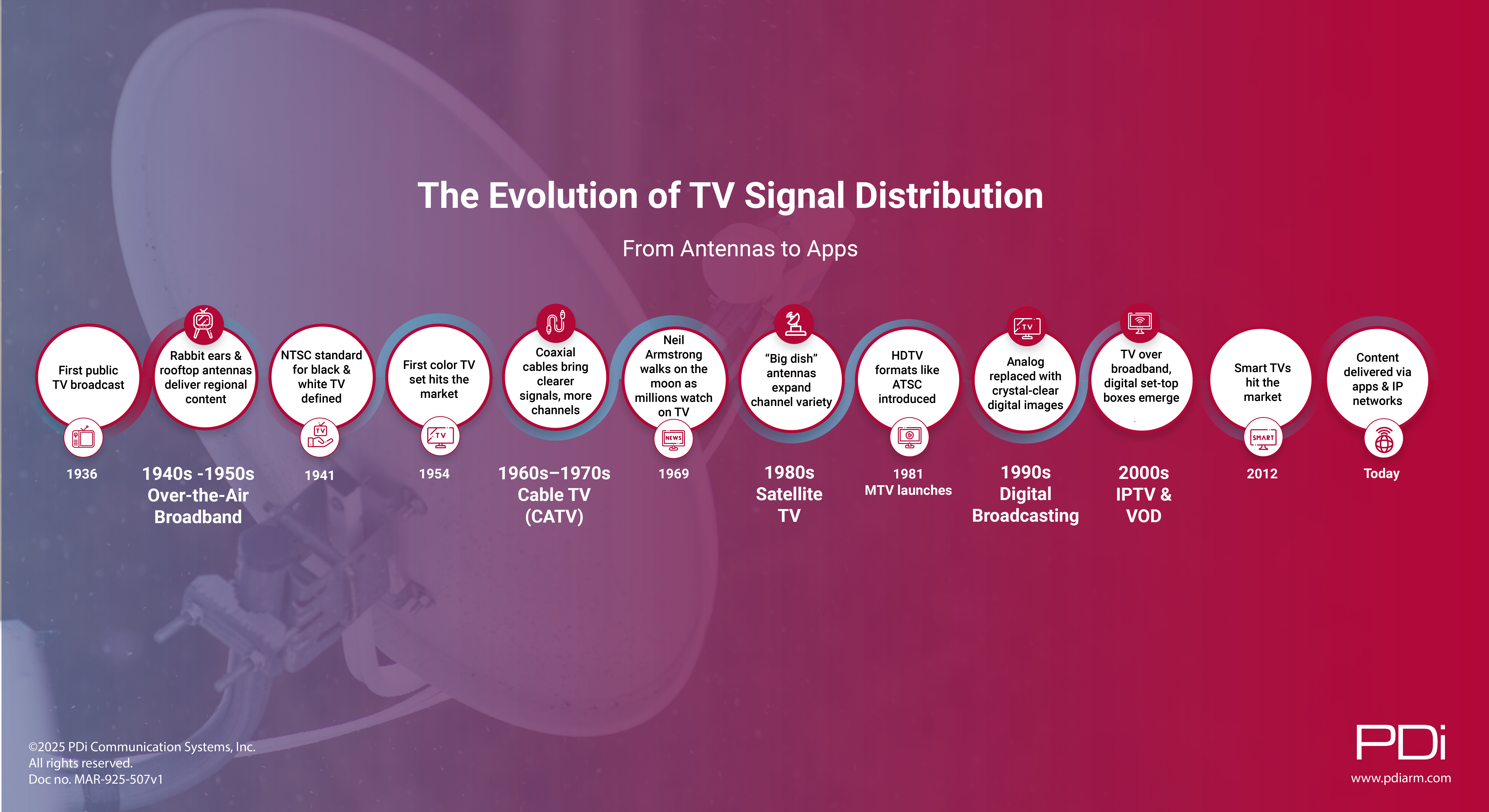
A glimpse at the history and evolution of TV signal broadcasting:
Layer Four: Power and Installation Options
Hospital displays can be powered through regular AC outlets, low-voltage systems, Power over Coax (PoC), or Power over Ethernet (PoE), depending on the hardware and room infrastructure. Choosing the right architecture can reduce electrical work, simplify retrofits, and help your facility reuse existing infrastructure.
The following considerations can help:
- Choose power and installation options that prioritize safety, reliability, and easy maintenance.
- Use PoE where appropriate to simplify cabling.
- Ensure all installations support comfortable patient viewing, proper ventilation, cable management, and service access.
Layer Five: Remote Device Management (RDM)
Managing large patient TV fleets manually can be overwhelming, which is why device management and CMS tools are valuable. Hospital RDM software allows authorized staff to remotely configure, manage, and monitor multi-campuses. These platforms can also perform diagnostics and apply remote firmware and application updates across hundreds or thousands of devices, saving hospital staff time and effort.
Some questions to ask when buying an RDM tool are:
- Does it integrate seamlessly with my EHR?
- Is it compatible with the patient engagement tools I want to offer?
- Does it have strong security and data privacy features?
- Does it offer reliable, long-term vendor support?
- Will is support future facility growth?
If the answer is yes for each of these, you're looking in the right direction.
Checklist: Achieving Your In-Room Patient Entertainment Goals.
A solid patient entertainment system benefits both patients and hospitals alike. Getting it right can be rewarding. Getting it wrong can be costly.
A checklist for hospital, clinic, and senior living center facility managers:
- Is the system UL/cUL listed for healthcare?
- Does it integrate with my pillow speaker/ nurse call infrastructure?
- Does it support Pro:Idiom®?
- What are the power options, i.e., PoC, PoE, low voltage?
- Can it run entertainment with no internet/ no Protected Health Information (PHI) exposure? What's the security posture when it is connected?
- How is the fleet managed remotely? What does a firmware update across 300 rooms look like?
- Where is support based, what's the warranty, and will parts exist 7 years from now?
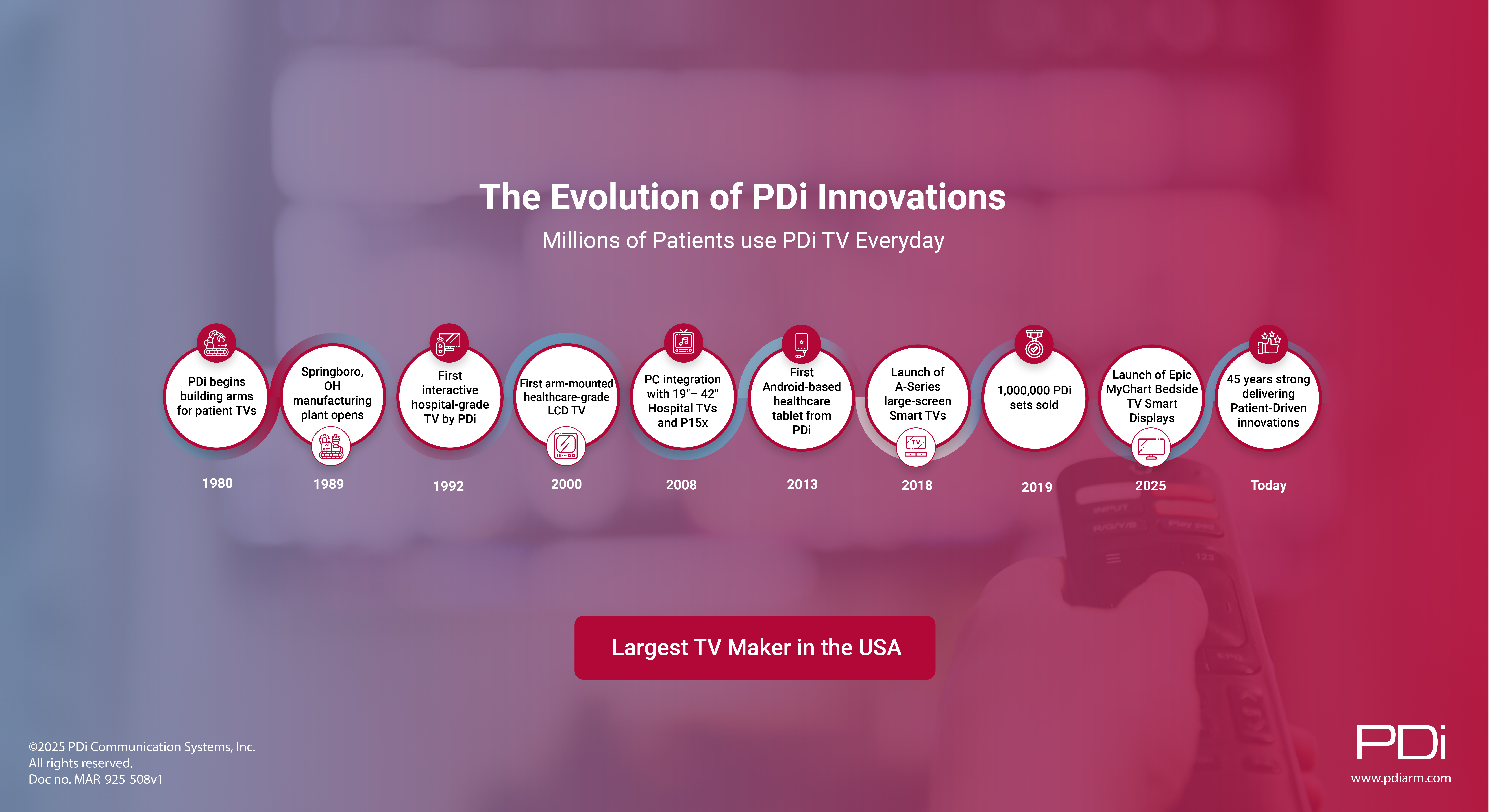
PDi Communication Systems, Inc., can help your facility optimize patient entertainment. Our company has been a leader in premium patient TV solutions since 1980. We offer an all-in-one patient entertainment ecosystem that includes healthcare grade TVs, medTABs, TV boxes, mounts, and power supplies. We also provide GENiOTM, an affordable cloud-based hospital RDM tool that simplifies large TV deployments.
A-Series
Smart TVs
24" - 65"
Our flagship all-in-one smart wall TV.
Five display sizes, unlimited patient spaces
Learn More →
K-Series
Non-Smart TVs
24" - 43"
UL-Listed Hospital-grade Non-smart TVs
Pair the 32" in portrait mode with a PDi TV Box for digital whiteboard.
Learn More →
PDi TV Box
The Smart Room Command Center
One Simple Set Top TV Box Experience to Deploy Epic MyChart Bedside TV Smart Displays on Any Display
Learn More →
GENiO
Remote Device Management
Transform the patient screen into a clinical command center that automates workflows and feels like home for the patient.
Learn More →
medTAB22
22" Touchscreen Smart Patient TV
Customize Your Patient Experience with GENiO™ Cloud Management.
This model is also a direct replacement for medTAB19.
Learn More →
medTAB16
16" Touchscreen Smart Patient TV
Customize Your Patient Experience with GENiO™ Cloud Management.
This model is also a direct replacement for medTAB14.
Learn More →
medTV6
16" Personal Patient TV
The Standard in Complete Personal Patient TVs.
This model is also a direct replacement for medTV14 and Persona P10.
Learn More →
Factory-certified
Expert Services by PDi ProServices
Minimize project risks by consulting with PDi ProServices and guarantee your installations.
Learn More →
Ohio-based PDi is proud to be the largest TV maker in the United States. For over 45 years, we have delivered premium reliability in patient-room technology designed, built, programmed, and supported in the USA.
Frequently Asked Questions
What is Pro:Idiom and Why Does it Matter?
Pro:Idiom® is a digital rights and encryption technology mainly used by hotels and hospitals. It matters for patient entertainment because it lets facility staff safely send HD and 4K TV channels to rooms without needing a separate cable box for every TV.
What Should My Evaluation Checklist Include When Buying a System?
Your checklist should include evaluating if the system is UL/cUL listed for healthcare, integrates with your pillow speaker/nurse call infrastructure, supports Pro:Idiom®, has flexible power options (PoC, PoE, low voltage), offers secure offline capabilities, can be managed remotely across hundreds of rooms, and comes with strong long-term warranty and parts support.
How Does Patient Entertainment Reduce Nurse Calls?
Patients often make more nurse calls when they feel bored and isolated. Patient entertainment and interactive bedside systems can reduce these calls by keeping patients actively engaged, freeing up valuable time for nurses and making them more efficient.
Sources
- PubMed Central - Effectiveness of psychological intervention package on anxiety and wellness level among patients with anxiety disorders
- National Library of Medicine - A systematic review of the comparative effects of sound and music interventions for intensive care unit patients' outcomes
- National Library of Medicine - Activities on acute mental health inpatient wards: A narrative synthesis of the service users' perspective
- National Library of Medicine - National Patient Satisfaction Survey as a Predictor for Quality of Care and Quality Improvement – Experience and Practice
- CMS.gov - HCAHPS: Patients' Perspectives of Care Survey
- Deloitte - The value of patient experience
- Fortinet - What Is Quality Of Service (QoS) In Networking?
- Pro:Idiom- Zenith