




Key Takeaways
- Healthcare grade TVs are UL-listed for healthcare, which means they meet rigorous safety, durability, and performance standards specifically for use in medical facilities. They also have less shock potential for users including patients with an IV break in their skin.
- Unlike consumer TVs, healthcare TVs do not use petroleum-based plastics and can self-extinguish in case of fire.
- Healthcare TVs also have antimicrobial properties and are specifically designed to withstand continuous cleaning and sanitizing agents. This reduces the risk of hospital-acquired infections.
- Being compatible with pillow speakers also means healthcare TVs have a positive impact on patient satisfaction. These allow private listening to music, podcasts, or television, which reduces noise in patient rooms.
- These benefits matter because patient safety, patient experience, and patient satisfaction are considered key measures of healthcare quality.
Television in Medical Centers
Television in medical centers is no longer just a bonus. It is now a core part of healthcare infrastructure. Many medical sources say watching TV as a recreational activity during hospitalization reduces anxiety and improves relaxation. TVs can also support virtual nursing.
Some clinics, to this day, use regular consumer grade TVs in patient areas. These standard TVs are, however, not designed for medical facilities but for personal use in private spaces like homes.
This matters because healthcare environments are complex and uniquely designed to balance medical care, infection control, and patient comfort. So each component of these environments must be carefully thought through before installation, including TVs.
Installing regular consumer TVs may seem cheaper at first but can create problems for your facility. Healthcare grade TVs, on the other hand, are specifically designed for the industry and can meet its unique needs. If patient safety, comfort, and engagement are a priority, healthcare TVs are a better fit than consumer TVs.
What is a Healthcare Grade TV?
A healthcare grade or hospital grade TV is a specialized display designed for patient safety, infection control, and clinician engagement. You will typically find these TVs in:
- hospitals
- dialysis clinics
- post-acute and rehab facilities
- outpatient surgery centers
- senior living communities
For a device to qualify as "healthcare grade" or "hospital grade," it must have an Underwriters Lab (UL) Certification.
UL Listing
UL is an independent safety science institution that tests, certifies, and sets standards for products to ensure safety, sustainability, and security. UL certification ensures the device meets construction and safety standards required for a particular use case.
For the healthcare industry, UL has a "hospital grade listing" which is awarded to products that meet rigorous safety, durability, and performance standards specifically for use in healthcare facilities.
The criteria for this special listing have changed over time. Older healthcare TVs were commonly evaluated under a framework known as UL 60065 Annex Q. Today, new healthcare TVs and displays are generally analyzed under UL/CSA 62368-1 Annex DVB which has updated safety requirements.
.png)
Standards: These include but are not limited to:
- plugs, receptacles, and power strips that are more durable than consumer versions
- higher-grade housing
- higher assembly integrity and mechanical strength
- stronger grounding, etc.
Existing Products: Products certified to the older UL 60065 or UL 60950-1 framework may maintain certification unless a design change is made, at which point they may need to be evaluated again under UL/CSA 62368-1.
These requirements put together mean a UL-listed-hospital grade product is not just high-quality, but is specifically designed to withstand the high demands of a medical environment.
But quality and demand are only a part of the story. Regulatory compliance is another side.
UL hospital grade receptacles are required by codes such as NEC Article 517 and NFPA 99 in patient care areas of healthcare facilities, where superior grounding reliability and durability are essential. So investing in healthcare grade systems goes beyond doing the right thing- it helps your facility stay compliant. Still, there are many other reasons why healthcare displays matter.
How do Healthcare TVs Differ from Standard Consumer TVs?
Healthcare grade TVs are crucial in modern healthcare because patient experience matters now more than ever. A 2023 research review published in the International Journal of Hospitality Management shared that patient-guest experience influences health and well-being and determines people's willingness to use a service again or recommend it to others.
A 2020 Sage Journal study also noted that patient experience is now globally recognized as an independent measure of healthcare quality. The paper added that new policies now link how hospitals and clinicians are paid to how patients rate their experience. There is also more focus on keeping patients involved in their care, as healthcare is increasingly seen as a service where people expect good value. One way to provide this value is to deploy patient-centered technology such as healthcare grade TVs.
Leakage Current and Patient Safety
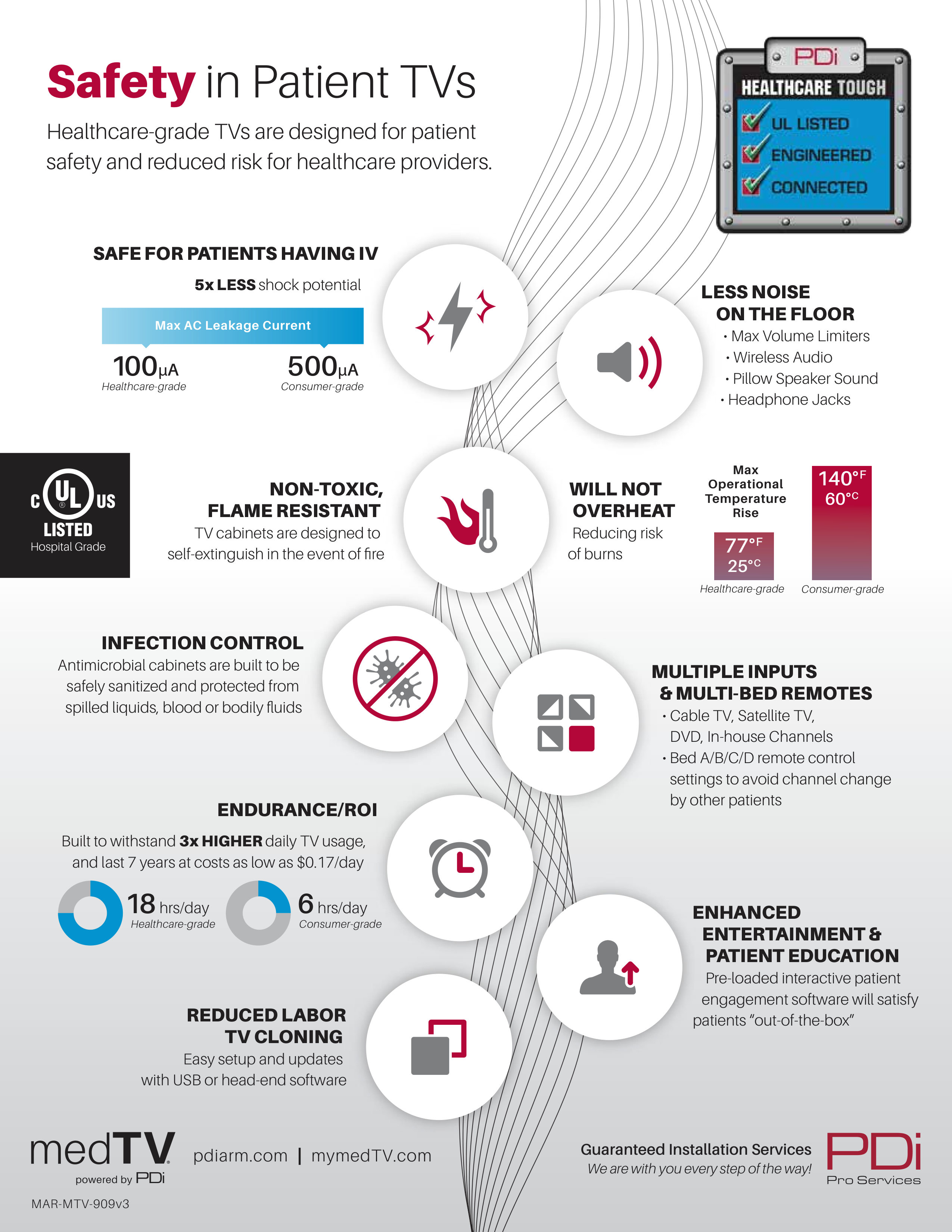
One assumption consumer TV manufacturers make is that users are generally healthy. This assumption disregards the risks associated with leakage current, the small amount of electricity that flows through devices even when they are turned off or insulated. Consumer TVs have a typical allowable leakage current of about 500μA. This may be harmless to healthy users but can be dangerous to individuals who have health problems and may be more susceptible to shocks. Also, medical devices such as pacemaker programmers, ECG leads, and catheters make it easier for electric current to reach internal organs. As a 2025 peer-reviewed research paper explains, even tiny currents can cause shocks, burns, or interference with life-support equipment.
But patient risk is not the only concern here. There's also potential litigation. Leakage current that does cause harm can lead to medical liability lawsuits that could financially ruin a healthcare institution. The National Practitioner Data Bank, a data analysis tool provided by the U.S. Department of Health and Human Services (HHS) shares these U.S. medical liability statistics:
- The U.S. recorded 53,000 medical malpractice claims between 2019 and 2023, which led to total money payments of over $20.2 billion.
- There were 11,248 medical malpractice cases and over $4.67 billion in payments in 2023 alone.
- Almost half of all successful medical malpractice claims involved allegations of negligence during inpatient stays.
Hospital infrastructure hazards can contribute to negligence claims. So you're doing your facility a great service when you put all the necessary measures in place to reduce the likelihood of a medical liability lawsuit. Installing healthcare TVs is one such measure as they often have a low leakage current of 10-100µA. This leakage current range is typically safe for all users, including patients with an IV break in their skin.
Infection Control and Easier Cleaning
Electronic devices are, by reason of use, transmission vehicles for germs. Grim amounts of germs build up on handheld devices, touchscreens, and TV remotes and can easily spread between surfaces, increasing the risk of infection. This is especially true in healthcare settings where pathogens tend to be more concentrated.
According to a 2021 study, not disinfecting a device at least once a day leads to the device having as much bacteria as items that were never cleaned. This is concerning because many consumer electronics are not built for repeated cleaning and can sustain permanent damage if subjected to this.
Healthcare TVs address that problem by being specifically designed to withstand continuous cleaning and sanitizing agents. Additionally, many healthcare TV systems have anti-microbial properties, which add an extra layer of protection.
Endurance, Thermal Requirements and Flame Resistance
Consumer grade TVs are typically designed for roughly 4-6 hours of operation per day. They lack the type of power supplies, fans, and proper ventilation needed to dissipate heat during 24/7 operation. Continuous use can cause heat to build up internally, causing overheating of up to 140°F and degrading components like capacitors. Overheating can also cause burns and raise the risk of a fire outbreak.
In fact, the U.S. Fire Administration reports that appliances were the leading cause of serious medical facility fires (21%) between 2014 and 2016, followed by electrical malfunction (18%). Other causes include intentional actions (9%), heating (7%), other unintentional actions (7%), and other heat (7%).
You can reduce the risk of these fires by replacing your facility's consumer TVs with healthcare grade versions. Most modern hospital grade TVs can withstand 18+ hours of daily usage at a modest maximum operational temperature rise of around 77°F. Also, hospital TV cabinets do not use petroleum-based plastics and can extinguish themselves in case of fire.
All these unique features translate into greater safety for patients, visitors, and clinicians.
| Specification Matrix | Standard Consumer TV | Healthcare Grade TV |
|---|---|---|
| Allowable Leakage Current | Dangerous (Up to 500μA) | Safe for IV Patients (10-100µA) |
| Designed Daily Operation | 4-6 Hours | 18-24+ Hours Continuous |
| Infection Control Durability | High risk of chemical damage | Withstands harsh hospital sanitizers |
| Pillow Speaker Capability | None | Yes |
| Warranty Status (24/7 Use) | Voided or reduced to 90 days | Full 2-5 Year Coverage |
Warranty
As Data Projections reports, most consumer TV manufacturers specifically state in their warranties that continuous, commercial-level use is not covered. Using these TVs 24/7 often voids the warranty completely or reduces it to a 90-day period. Additionally, displaying static images like menus or channel logos for extended periods can cause permanent "burn-in" or image retention, which is explicitly excluded from standard warranties.
Conversely, healthcare grade TVs offer longer, more comprehensive warranties, often 2-5 years with options for up to 5 years. Healthcare TVs also typically offer better technical support, which often includes on-site hardware and software services. This means technicians come to the facility to fix the TV, which prevents the need to remove it from the patient room.
Pillow Speaker Interface and Noise Reduction
Regular smart TVs typically use universal remotes or smartphone apps like SmartThings or Google TV for navigation, power, and volume control, often connecting via Wi-Fi or Bluetooth. While these are innovative, other useful options like pillow speakers are not offered, which takes away all the unique benefits of using pillow speakers, such as:
- allowing private listening to music, podcasts, or TV, which reduces noise in patient rooms
- helping mask external noise, promoting relaxation, and making it easier to fall asleep
- providing a way for clinicians to communicate with patients
In addition to a pillow speaker interface, many modern healthcare TV systems support wireless audio and headset usage, which further supports patient privacy.
Added Functionality
Unlike consumer and commercial TVs, healthcare grade displays, especially smart hospital TVs, are designed to integrate with EHR systems and virtual care platforms. This means patients can access personalized educational content related to their condition, medications, and recovery, which helps reinforce what clinicians explain. Many platforms also allow patients to view their daily schedules and complete basic surveys. This makes the experience more convenient and gives patients a greater sense of involvement in their care.
Smart hospital TVs also offer unique relaxation or distraction content to help reduce stress and provide digital tools for communication or feedback. In some care environments, they can even display helpful information such as facility details. This level of integration not only boosts the care experience for patients but also streamlines clinician workflow.
Clinician Workflow
Nurse efficiency is no longer just an operational concern. It is now a key factor in both patient outcomes and the financial performance of healthcare systems. Studies show that nurses spend nearly 75% of their time on nursing-related tasks, yet only about 37% of their total time is spent directly with patients. This gap is largely driven by inefficiencies, especially delays in communication between patients and care teams. In fact, experts estimate that more than $12 billion is wasted annually in the U.S. due to these breakdowns in connection and coordination.
Many of these inefficiencies come from something deceptively simple: how patients communicate their needs. Traditional systems, like basic call buttons, provide little context. A nurse is alerted but not informed, forcing them to stop what they're doing, enter the room, and assess the situation. Multiply this across dozens of patients and hundreds of interactions per day, and the result is constant interruption, unnecessary movement, and lost time that could otherwise be spent on direct care.
Healthcare grade TVs are designed with this reality in mind. With these, patients can submit specific requests and interact with hospital systems directly through the screen. This allows requests to be categorized and prioritized, reducing guesswork and minimizing unnecessary room visits. The result is a more streamlined workflow where nurses can respond more efficiently instead of reactively.
Signs It's Time to Upgrade Your Facility's TVs
If your facility lacks any of the healthcare TV benefits outlined above, it may be time to upgrade your systems. More so if you're experiencing frequent system failures, slow smart functionalities, or obsolete technology.
Here are additional reasons to upgrade your facility's TVs:
Upgrade
Inconsistent TV models across patient rooms
Compatibility issues
Frequent complaints about usability or picture quality
Inability to support patient engagement goals
Renovation or room modernization projects underway
Facility growth and expansion
Who Should Care About Healthcare Grade TVs?
Because a hospital's digital systems impact finances, brand image, and patient care, every member of the organization should take an interest in them. The table below explains who should care most about healthcare grade TVs and why.
| Who should care | Why they should care |
|---|---|
| Hospital administrators | Patient room technology influences patient satisfaction scores, which, in turn, can affect a hospital's reputation and bottom line. |
| IT staff | TVs may connect with hospital systems, EHR platforms, and nurse call workflows. Having a uniform, compatible, and secure TV system matters. |
| Facility and procurement teams | Downtime, excessive support calls, and shorter lifespan can make consumer TVs more expensive over time. |
| Clinicians | When equipment is unreliable or confusing, clinicians often end up troubleshooting it. This is time spent away from important clinical duties. |
What to Look for When Buying a Healthcare Grade TV
How to Choose a Hospital TV
Selecting the right hospital TV matters just as much as the decision to upgrade. You want to make sure you're investing in a solution that provides all the key benefits.
The first thing to look out for is the UL hospital grade label, which guarantees the TV meets strict medical standards.
The next step is to confirm that the TV has a pillow speaker port, which is a key differentiator for hospital TVs. Getting TVs that support a universal pillow speaker is especially helpful.
You also want to make sure the TV system integrates seamlessly with your nurse call system and EHR platform and provides quality relaxation, infotainment, and communication tools. In other words, the software on the TV must be able to support your patient engagement and clinician workflow goals.
Why the Right Vendor Matters
Choosing the right vendor matters a great deal in all of this. Trusted vendors should have:
- Significant healthcare experience
- Product consistency
- Rollout and installation support
- Software account support
- Warranty/Service model
- Ability to support growth
With over 45 years' experience in the industry, Ohio-based PDi Communication Systems, Inc. is the leading U.S. manufacturer of patient television systems. PDi delivers UL-listed, healthcare grade displays and TV arms that meet strict safety, infection control, and integration standards. PDi also offers GENiO™, an affordable cloud-based device management tool that streamlines the patient experience using Epic MyChart Bedside TV. Talk to PDi today about upgrading your facility's TVs.
Hospital TVs for the Modern Patient Room
Transform the hospital experience with secure, reliable, and patient-centric smart room solutions or choose Standard TV only, great for Long-term Care.
Learn More →
Arm-mounted
Personal Patient TV & Touchscreen Systems
Engineered and assembled in Springboro, Ohio. Our complete solutions fit every healthcare space from dialysis to private suites.
Learn More →
GENiO Remote Device Management
Transform the patient screen into a clinical command center that automates workflows and feels like home for the patient.
Learn More →
Factory-certified
Expert Services by PDi ProServices
Minimize project risks by consulting with PDi ProServices and guarantee your installations.
Learn More →
Conclusion: Fine-tuning Your Patient Experience
Healthcare grade TVs in medical centers are not just a nice to have. They help a great deal with everything from regulatory compliance and patient engagement to infection control and clinician workflow.
If your facility prides itself on being patient-centered, you want to deploy only healthcare grade TVs for patient entertainment and engagement. Investing in the right technology and the right partner will help you deliver a safer and more connected patient experience.
Epic and MyChart are registered trademarks of Epic Systems Corporation.
Frequently Asked Questions
How do Healthcare TVs Differ from Hospitality TVs?
Both healthcare and hospitality TVs are commercial grade, but they have key differences. Unlike hospitality TVs, healthcare TVs are UL-listed for patient safety, infection control, and easy cleaning. Healthcare TVs are also unique in their pillow speaker compatibility.
How do Healthcare TVs Assist with Patient Rounding and Feedback?
Healthcare TVs typically integrate interactive EHR systems, virtual nursing portals, and other patient engagement tools, which allow for seamless communication between patients and care teams. Patients can also request services and participate in surveys.
How do Healthcare TVs Integrate with Pillow Speakers and Other Controls?
Healthcare TVs possess specialized multi-pin inputs designed natively for pillow speakers. This dedicated interface allows patients to control power, volume, and channels directly from their bedside, allowing private listening without ear-wear discomfort or disturbing other patients. Consumer TVs lack these ports, forcing facilities to rely on universal remotes that easily become lost or heavily contaminated.
Which Patient Entertainment Systems do Large Hospital Networks Use?
According to PDi Communication Systems , large hospital networks use a variety of patient entertainment and engagement systems, often centered around hardware that integrates directly with electronic health record (EHR) platforms like Epic.
Research Methodology & Citations
- PMC — Recreational Activities and TV Viewing in Medical Centers to Reduce Anxiety
- PubMed — Clinical Study on Patient Care Environments and Well-being
- PubMed — Infrastructure Impact on the Healing Process
- NESA Solutions — Virtual Nursing Technology and Architecture
- Epic — Epic MyChart Bedside TV Patient Engagement
- Curbell Medical — Pillow Speakers and Bedside Accessories for Infection Control
- Data Projections — Do I Really Need a 24/7 Display? Understanding Warranty Limits
- U.S. Fire Administration — Snapshot: Medical Facility Fires and Appliance Hazards
- PMC — Daily Disinfection and Pathogen Buildup on Electronic Devices
- PMC — Electrical Safety and Leakage Current in Healthcare Environments
- National Practitioner Data Bank (NPDB) — Medical Malpractice Claims Data Tool
- NCBI Bookshelf — Electrical Injuries and Vulnerability in Hospitalized Patients
- Sage Journals — Patient Experience as an Independent Measure of Healthcare Quality
- ScienceDirect — International Journal of Hospitality Management on Patient-Guest Experience
- NFPA — NFPA 99: Health Care Facilities Code
- State of Montana / NEC Article 517 — Health Care Facilities Electrical Compliance
- Underwriters Laboratories (UL) — Hospital Grade Receptacles and Grounding
- Underwriters Laboratories (UL) — Healthcare and Life Sciences Certifications
- PMC — Nursing Workflow: Time Spent on Direct Patient Care vs. Administrative Tasks