





Key Takeaways
- Nursing Efficiency: EHR-integrated patient engagement tools can offload up to 30% of non-clinical administrative tasks from nursing staff directly back to bedside care.
- Hardware/Software Lifespan: Healthcare hardware lifecycles span 7-10 years, while software requires continuous updates. A unified software ecosystem prevents the financial drain of premature hardware replacement.
- Retrofit Affordability: Strategic smart room capabilities can be achieved via set-top devices using existing displays, avoiding the $1,200–$2,000 per-room cost of a full physical replacement.
- Phased Implementation: A sustainable deployment follows four distinct stages: Access & Autonomy, EHR Integration (e.g., Epic MyChart Bedside TV), Patient Onboarding, and Scale & Remote Management.
- Update Cadence: The gap between hospital hardware lifecycles and software update cadences is the most underappreciated risk in healthcare IT modernization.
Innovation vs. the Trend Trap
The healthcare industry is under pressure from every direction. Nursing shortages, rising patient expectations, and razor-thin operating margins have pushed hospital leadership to explore technology at a pace most IT departments were never designed to absorb. Vendors are eager to fill the void, and many are doing so with consumer-grade gadgets dressed up in clinical packaging.
For IT directors, the result is a procurement cycle that outpaces your infrastructure roadmap, followed by a wave of support tickets, compatibility headaches, and hardware that goes end-of-life before the warranty expires. This is the trend trap that costs hospitals far more than most administrators realize.
A truly smart hospital room is not defined by the newest technology on the market. It is defined by a sustainable, reliable strategy that accounts for the realities of healthcare IT infrastructure, clinical workflows, and capital budget cycles. The hardware lifecycle in a healthcare environment typically spans 7 to 10 years. The software layer also changes continuously. Buying consumer-grade devices to bridge these two realities often results in an IT nightmare that keeps repeating itself.
The Strategic Imperative: Why Smart Rooms Can’t Wait
There is a temptation to treat smart hospital room technology as a “nice to have” — something to revisit when budgets improve or when the staffing crisis levels off. That window may not come.
The Efficiency Crisis Is a Staffing Crisis in Disguise
Mercer projects a shortfall of more than 100,000 healthcare workers nationwide by 2028, and HRSA forecasts an 8% registered nurse shortage for that year. For hospital administrators, this is an existential problem. For IT directors, it translates into direct, increasing pressure to deploy technology that offloads non-clinical tasks from nursing staff.
The operational burden of those non-clinical tasks is significant. A peer-reviewed time-and-motion study published in the Journal of Advanced Nursing found that nurses spend as little as 21% of their shift on direct patient care — with the remainder consumed by documentation, logistics, and administrative work. A McKinsey analysis of the nursing workload reinforces this finding: the single fastest way to close the workforce gap is to reduce the non-clinical burden on the nurses already in place.
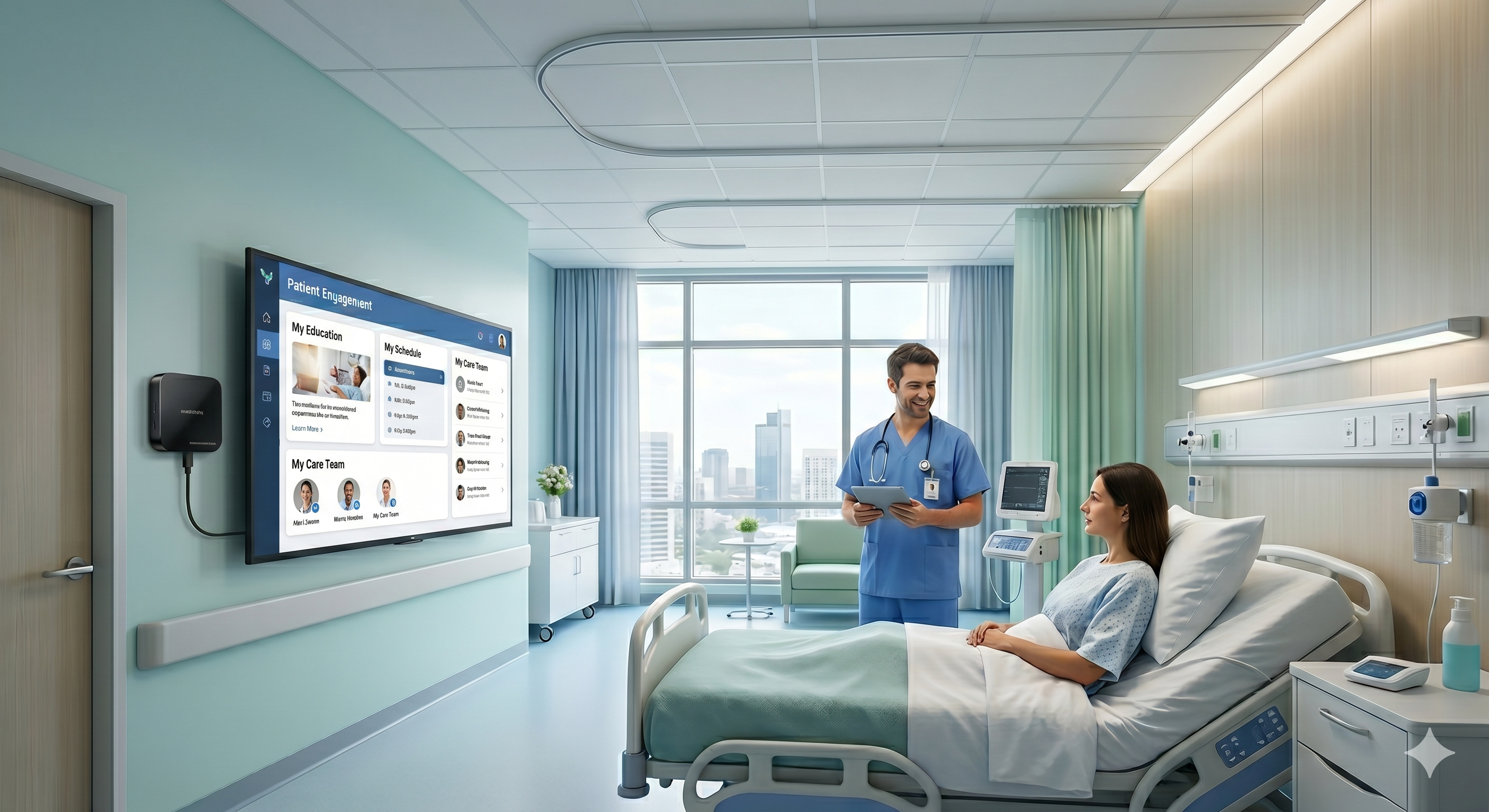
A properly designed smart hospital room functions as a digital teammate. Patient education, discharge instructions, entertainment, care team communication, and basic service requests can all be handled by the room technology stack — freeing nurses to focus on what requires their clinical judgment. Research suggests that technology could offload up to 30% of administrative tasks from nursing staff, time that goes directly back to the bedside.
Budget Reality: Modernize Without the Capital Spike
Most hospitals do not have the capital budget for a full-scale technology overhaul. A complete room renovation — new displays, new mounts, and new cabling infrastructure can run $1,200 to $2,000+ per room or more. Additional virtual care camera technologies will increase upgrade costs, typically ranging from $4000-$8000+. Across a 200-bed facility, that is a project most CFOs will defer indefinitely. The smarter path is a phased, retrofit-first approach, which transforms existing patient room display infrastructure into an intelligent patient engagement hub without a full rip-and-replace.
Compliance and Regulatory Pressure
CMS and the Joint Commission’s patient-centered communication standards continue to tighten requirements around patient communication, safety monitoring, and data transparency. Smart room technology, implemented with the right infrastructure, converts compliance from a manual checklist into an automated workflow. Integrated solutioons can systematically document patient education, care plan acknowledgment, and communication touchpoints at every admission.
The Unshared Pace of Hardware and Software
This is the section most vendors will not walk you through in detail because understanding it makes you a more demanding buyer.
Hardware Reality
UL-Listed healthcare-grade hardware is typically engineered for a lifecycle of 7 to 10 years or more. That is the pattern hospital infrastructure is used to, and what capital budgets expect. Consumer-grade devices operate on a completely different timeline. Tablets, off-the-shelf smart televisions, and retail touchscreens are refreshed annually by their manufacturers, with security patches and software support typically ending a few years after release.
For a 300-bed hospital that deploys consumer tablets in every room, that means a full device refresh every two years. This is a recurring capital expense that no original budget anticipates, and that no clinical stakeholder will want to hear about at the next board meeting.
Software Reality
On the software side, the rate of change is equally relentless. Epic MyChart Bedside TV releases updates on a quarterly cycle, and Becker’s Hospital Review has documented as many as 14 significant platform changes within a single 30-day window. CMS interoperability mandates evolve annually. Patient-facing applications are expected to integrate with consumer health tools and telehealth platforms that were not on the market years ago.
The gap between hospital hardware lifecycles and software update cadences is the most underappreciated risk in healthcare IT modernization. A device that was fully functional at deployment can become a compliance liability within 18 months if the underlying hardware cannot support the software it is expected to run.
The Strategic Solution: A Unified Software Ecosystem
The answer is not to slow down software adoption — that ship has sailed. The answer is to embrace a unified software ecosystem that serves as the virtual interface of the smart hospital room, capable of supporting both your existing legacy displays and new patient room TVs. This means investing in healthcare-grade hardware designed to deploy software that is modular, natively supported, and is built to integrate with your EHR, regardless of the physical screen it runs on.
When an application is updated or a new integration is required, you update the software across the fleet. Your capital investment remains intact across the full lifecycle. For IT directors, this distinction is the difference between a smart room deployment that delivers long-term ROI and one that quietly generates a recurring capital expense that no one budgeted for.
Affordability and Retrofitting: Work With What You Have
The most common objection IT directors encounter when proposing smart room initiatives is an entirely reasonable one: “We cannot afford to replace every display in the building.” They are right. However, this is not what a retrofit strategy requires.
The Set-top Box Approach
A purpose-built healthcare-grade set-top device can transform an existing patient room display into a fully functional smart room hub. Rather than replacing infrastructure your facility has already invested in, a retrofit device connects to the existing television and delivers the complete smart room feature set. As Healthcare IT News reports, the benefits of smart room technology, including reduced nurse call volume, improved patient satisfaction scores, and lower readmission rates, are achievable without a full room renovation.
A smart hospital room, as defined in peer-reviewed literature, is characterized by its integration of digital health tools, sensor networks, and communication systems that work together to support patient care and clinical workflow — not by any single device or price point. A retrofit approach can achieve that integration without a capital construction project.
The Cost Comparison
| Implementation Metric | Traditional Rip-and-Replace | The Retrofit Strategy |
|---|---|---|
| Capital Expenditure | $1750+ per room | $1000 (typical) |
| Hardware Required | New displays, mounts, cabling, infrastructure (excludes virtual care cameras) | Purpose-built set-top device (reuses existing displays) |
| Patient Disruption | High (Requires taking rooms offline) | Minimal (Wing-by-wing execution while active) |
| Speed to Value | Quarters or Years | Weeks |
Immediate Scale, Immediate Impact
Smart room deployments that rely on retrofit hardware can be stood up across entire wings without construction schedules, room downtime, or extended patient disruption. For IT directors managing deployments across active clinical environments, that operational continuity matters as much as the technology itself. The ability to demonstrate smart room capabilities in a pilot wing — quickly, cleanly, and without a capital construction project — is also what gets the next phase approved.
Implementation Strategy: A Four-Stage Framework
A successful smart hospital room deployment is not a single event. It is a phased journey, with each stage building on the last, expanding functionality as your team becomes familiar with the platform and your clinical stakeholders develop confidence in the technology.
Stage 1: Access and Autonomy — Why the Basics Are Non-Negotiable
The foundation of any smart room deployment is giving patients reliable, intuitive control over their immediate environment. Pillow speakers, articulating mounts, and an entertainment platform that work every time are not entry-level features — they are the entire credibility of the system in the eyes of nursing staff. Consumer devices break. Mounts wobble. Remote controls disappear. The operational burden of maintaining Stage 1 functionality determines whether your clinical stakeholders trust the system enough to use Stages 2, 3, and 4.
Stage 2: EHR Integration — Where Due Diligence Is Non-Negotiable
Stage 2 is where a smart hospital room system transitions from a patient amenity to a clinical tool. Full integration with your EHR connects the patient-facing interface to live clinical data, ensuring that:
- Care team assignments update automatically.
- Medication schedules appear on the patient screen.
- Discharge instructions populate from the chart.
- Patient-reported outcomes flow back into the record.
For IT directors, this is where vendor qualification requirements are highest. EHR integration means API access, active HL7 or FHIR compliance, and sustained compatibility through your EHR’s quarterly update cycles. A vendor whose integration team has not maintained live deployments through multiple major releases is a vendor who will create urgent helpdesk work during your next upgrade window. Reference checks on EHR integration track record are a prerequisite and not optional.
Stage 3: Patient Onboarding — Returning Time to the Bedside
With a stable access layer and EHR connection in place, Stage 3 introduces patient-guided onboarding. Patients arrive to find a device that walks them through their care plan, introduces their care team, and delivers condition-specific education in their preferred language. Research on smart room clinical outcomes shows that EHR-integrated patient education platforms can save nursing staff significant time per admission — time that goes directly back to direct patient care. This is also where the patient portal becomes a bedside interface, giving patients visibility into their schedule, test results, and discharge plan without requiring a nurse to serve as a messenger.
Stage 4: Scale and Remote Management
Stage 4 transforms your smart room deployment from a clinical asset into a managed infrastructure layer. Cloud-based device management gives your IT team visibility across every device in the facility — firmware versions, connectivity status, usage patterns, and alerts — from a single console. Remote nursing integration expands the system’s clinical utility further, enabling care teams to conduct check-ins, answer patient questions, and complete documentation without physically entering the room. For infection control, isolation protocols, and high-census periods, this capability has direct operational value that your clinical leadership will understand immediately.
The Reliability Factor: What Doesn’t Make It Into the Demo
Every vendor can produce a compelling demonstration. The interface is clean, the integration slides look professional, and the technology performs flawlessly in a controlled environment. What no demo shows you is what happens at 2:00 a.m. when a device fails in the ICU and your on-call team needs support.
The Hidden Cost of Downtime
In a clinical environment, device downtime is not an inconvenience — it is a patient safety event and a nursing burden. Research by Censinet found that downtime costs hospitals an average of $7,500 per minute, with direct revenue losses of over $200,000 per incident. A failed bedside terminal in a smart room does not simply mean a patient cannot watch television. It can mean lost access to care team communication, missing patient education materials that were part of the discharge plan, and a nurse spending 20 minutes troubleshooting hardware instead of providing direct patient care.
Every support ticket has a cost — in nursing time, in IT hours, and in clinical confidence in the system. When you multiply that cost across a large deployment over a 7-to-10-year lifecycle, the total cost of ownership calculation shifts dramatically in favor of healthcare-grade hardware from vendors with proven support infrastructure.
US-Based Support Is a Clinical Requirement
For healthcare IT, support responsiveness is not a procurement preference — it is a clinical requirement. A vendor whose support team is overseas, understaffed, or operating on a 48-hour response SLA is not equipped to support healthcare-grade uptime. As a US-based manufacturer headquartered in Springboro, Ohio, PDi Communication Systems, Inc. engineers, builds, and supports our technology domestically. This means your facility has a direct escalation path to the very specialists who understand the system, completely eliminating overseas delays. This level of access should appear in your vendor selection criteria, not as a negotiating point after the contract is signed.
Brand Longevity and Vendor Stability
Healthcare IT deployments span 7 to 10 years. Your smart room vendor needs to be operational and actively supporting your platform for the full lifecycle — not just through the implementation phase. Evaluating vendor company history in healthcare includes:
- financial stability
- reviewing their healthcare-specific product roadmap
- conducting reference checks with existing healthcare customers
These are all due diligence steps that belong in the procurement process, not as afterthoughts once the system is live.
PDi Communication Systems, Inc. has focused exclusively on healthcare since 1980. Learn more about the hardware and software solutions plus services available today:
A-Series Smart TVs
24" - 65"
Our flagship all-in-one smart wall TV.
Five display sizes, unlimited patient spaces
Learn More →
PDi TV Box
The Smart Room Command Center
One Simple Set Top TV Box Experience to Deploy MyChart BedsideTV on Any Display
Learn More →
medTAB22
22" Touchscreen Smart Patient TV
Customize Your Patient Experience with GENiO™ Cloud Management.
This model is also a direct replacement for medTAB19.
Learn More →
medTAB16
16" Touchscreen Smart Patient TV
Customize Your Patient Experience with GENiO™ Cloud Management.
This model is also a direct replacement for medTAB14.
Learn More →
GENiO
Remote Device Management
Transform the patient screen into a clinical command center that automates workflows and feels like home for the patient.
Learn More →
Factory-certified
Expert Services by PDi ProServices
Quality products and quality service is PDi’s guarantee.
Learn More →
Conclusion: Build the Foundation, Not the Feature
That outcome does not happen by accident. It happens when IT directors are in the room during the procurement conversation — not just the implementation phase. When hardware lifecycle realities are built into the vendor evaluation framework from the start. When “retrofit-first” is a strategic posture, not a last resort.
The healthcare facilities that will lead in smart room technology over the next decade are not necessarily those with the largest capital budgets. They are the ones that made deliberate, strategic choices about the infrastructure layer they built to deploy now and in the future — and chose partners who understood the difference between a feature and a foundation.
Frequently Asked Questions
What is a hospital smart room?
A smart hospital room is a patient care environment that integrates digital health tools, sensor networks, communication systems, and EHR-connected interfaces to support both patient experience and clinical workflow. Unlike a standard patient room, a smart room gives patients direct access to their care information, entertainment, and communication tools while giving clinical staff real-time visibility into room status, patient needs, and device health. The defining characteristic is not any single technology — it is the integration of those technologies into a reliable, manageable system that supports clinical outcomes.
Do hospital rooms have cameras?
With the rise of virtual care, purpose-built edge computing devices with clinical-grade camera and two-way audio are becoming a foundational component of the smart hospital room. Solutions like those from Nesa empower clinical teams across the care continuum — remote nurses handling admissions, discharge education, and continuous patient monitoring; physicians conducting specialist teleconsults, telestroke response, and rapid response support; and care teams and interpreters collaborating across units and facilities — all from within their existing Epic MyChart Bedside TV workflow, with no new login and no new application.
This model of care reduces administrative burden on bedside staff, extends specialist coverage to underserved and rural facilities, improves patient safety, and delivers documented clinical outcomes across virtual nursing, virtual observation, and telehealth workflows. Unlike consumer video technology, these systems are purpose-built for the clinical environment — processing all data on-device within the patient room, with no PHI ever transmitted outside those four walls, and fully governed under HIPAA by design.
Research Methodology & Citations
- HRSA Nurse Workforce Projections, 2023–2038
- Mercer: Future of the US Healthcare Labor Market, 2028 Projections
- PMC — Time and Motion Study: How Do Nurses Spend Their Time? (Journal of Advanced Nursing, 2021)
- McKinsey — Reimagining the Nursing Workload: Finding Time to Close the Workforce Gap
- NurseJournal — AI Can Handle 30% of Nurses’ Administrative Tasks
- CereCore — Epic MyChart Bedside TV Quarterly Release Schedule: 3 Things You Need to Know
- Becker’s Hospital Review — 14 Epic MyChart Bedside TV Updates in 30 Days
- Censinet — Healthcare Downtime Costs Hospitals $7,500 Per Minute on Average
- GE HealthCare — 5 Equipment Lifecycle Essentials That Can Impact Patient Care
- Joint Commission — R3 Report: Patient-Centered Communication Standards
- Healthcare IT News — Smart Rooms Are Not Common, But Their Benefits Could Soon Make Them So
- Verizon Business — The Benefits of Smart Rooms in Hospitals
- Evideon — The Essential Role of Smart Hospital Rooms in Elevating Patient Care
- PMC — Smart Hospital Room Definition and Framework
- EpicShare — Technologically Advanced Hospital Rooms
.jpg)
